
Introduction#
A pair of gears looks simple until it has to last ten thousand hours. Two things kill gear teeth: the flank wears away by pitting, where the contact stress between the teeth is too high, and the root breaks, where the tooth bends like a small cantilever. Standards such as ISO 6336 and AGMA 2001 reduce both problems to a stress, an allowable stress and a safety factor, joined by a few dozen influence factors that took decades of tests to calibrate.
python-gearbox does two things with that knowledge:
It implements the standards faithfully. You describe the tool, the material, the gears and how the pair is driven; the library returns the stresses, the allowable stresses, the safety factors, and every intermediate factor under its full name, so you can see why a design passes or fails.
It lets you look closer than a standard can. It builds finite-element meshes of the real tooth shape, root fillet included, and solves them with CalculiX, so you can watch the stress move as the teeth roll through mesh and compare it with the standard’s prediction.
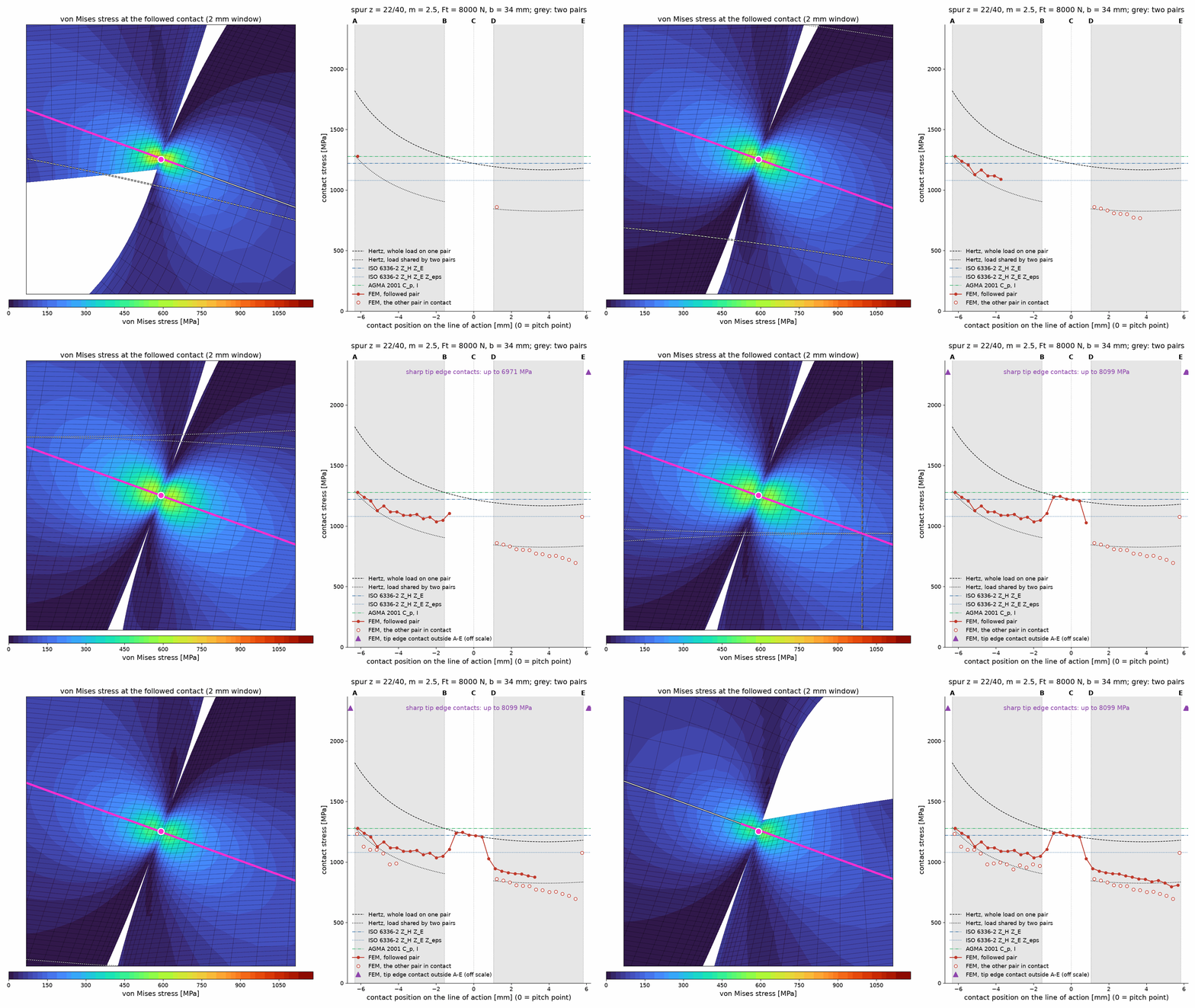
Contact stress of a spur pair (22 and 40 teeth, module 2.5 mm) as the teeth roll from the start to the end of contact. See Finite element model.#
Who this documentation is for#
Gear designers who want a scriptable, inspectable version of ISO 6336 or AGMA 2001.
Researchers who need a reproducible baseline for new models, or a source of tooth geometries and meshes. Every formula is cited by its number in the standard, and the tests pin the results.
Students learning how the standards work: the theory pages explain each factor before the formula, and then show the function that computes it.
How the documentation is organised#
Install the package and rate your first pair in ten lines.
Involute, rack, profile shift, tooth form, helical and internal gears, contact ratio and tolerances.
Pitting and bending by ISO 6336 and AGMA 2001: equations, factors and how the code evaluates them.
Distribute the profile shift between pinion and wheel within the geometric limits.
Structured meshes, bending and contact analyses with CalculiX, and post-processing.
Every class and function, generated from the docstrings.
Conventions#
Lengths are in mm, angles in degrees, stresses in MPa, forces in N, power in kW
and speeds in rpm. Symbols are those of the standards (\(d\), \(m_n\), \(\alpha_n\), \(\sigma_H\) …);
each field of a result carries its symbol in the docstring. Subscripts 1 and 2 are the pinion and
the wheel. All models are immutable dataclasses: to try a variant, copy with
dataclasses.replace.
Scope at a glance#
Standard |
What is implemented |
|---|---|
ISO 6336-1:2019 |
Influence factors \(K_A\), \(K_\gamma\), \(K_v\) (A, B, C), \(K_{H\beta}\), \(K_{F\beta}\), \(K_{H\alpha}\), \(K_{F\alpha}\), mesh stiffness |
ISO 6336-2:2019 |
Pitting: reference, limited-life and static stress; internal and double helical gears |
ISO 6336-3:2019 |
Tooth breakage (method B): hob and shaper cutters, internal and double helical gears |
ISO 1328-1:2013 |
Flank tolerances |
AGMA 2001-D04 / 908-B89 |
Pitting and bending stress, geometry factors \(I\) and \(J\), allowable stresses; pitting of internal gears |
The limits of each one are stated on its theory page. When a piece is missing and the answer
could be wrong because of it, the call raises ValueError instead of returning a doubtful number.
The known deviations from the standards are listed in
KNOWN_ISSUES.md.