
Finite element model#
The standards reduce a tooth to a handful of factors. The gearbox.fem package lets you look at
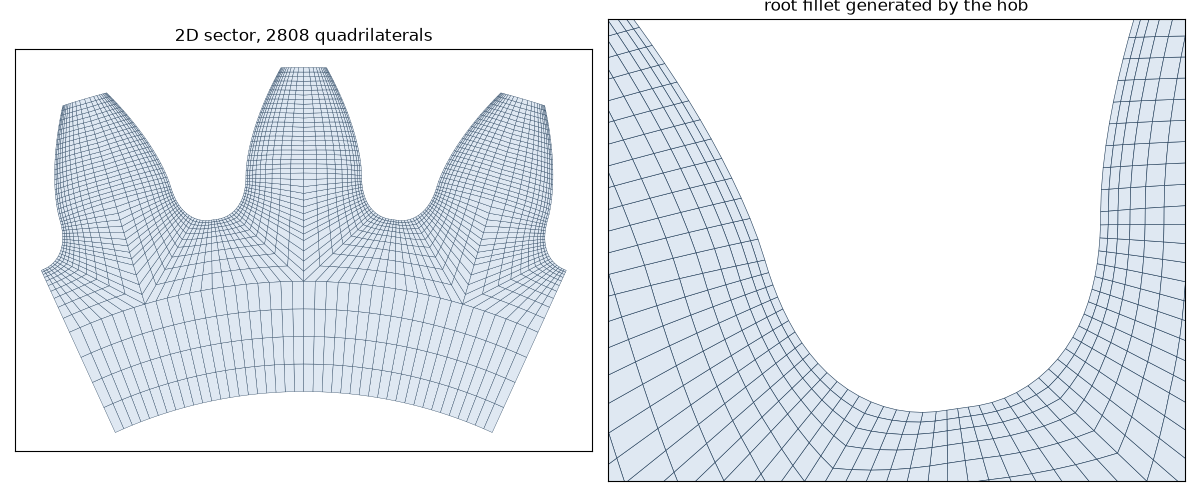
the tooth itself: it meshes the exact shape the hob cuts, root fillet included, and solves it with
CalculiX. You get the stress field of a loaded tooth, the contact pressure
between two flanks, and the way both change while a tooth rolls through the mesh.
from gearbox.fem import solve_bending, solve_contact

bending = solve_bending(transmission, "out", dimension="2D")   # root stress at the point D
contact = solve_contact(transmission, "out")                   # contact pressure at the pitch point
print(bending.max_principal_stress, contact.max_contact_pressure)
Here transmission is the pair of Quick start: a 22/40 spur pair of
module 2.5. The first call gives 318 MPa at the root of the pinion, the same as ISO 6336-3 to within
0.1 %. The second gives 1338 MPa, within 0.3 % of Hertz’ theory.
What you need to install, the workflow from mesh to results, what has been validated and where the limits are.
Structured quad and hex meshes of one gear or a pair in mesh: the blocks, the element sizes, the named groups, the output files.
solve_bending: one tooth loaded at the outer point of single pair contact, the root stress and
how it compares with ISO 6336-3.
solve_contact: a pair pressed together by a torque, the contact pressure and Hertz’ theory as
the reference.
Hexahedral meshes, helical twist, 3D bending and contact, computational cost and convergence limits.
The line of action, sweeps along the path of contact, contact patches and plots with matplotlib.
Every class and function of gearbox.fem.mesh, gearbox.fem.calculix and gearbox.fem.post.