
Meshing#
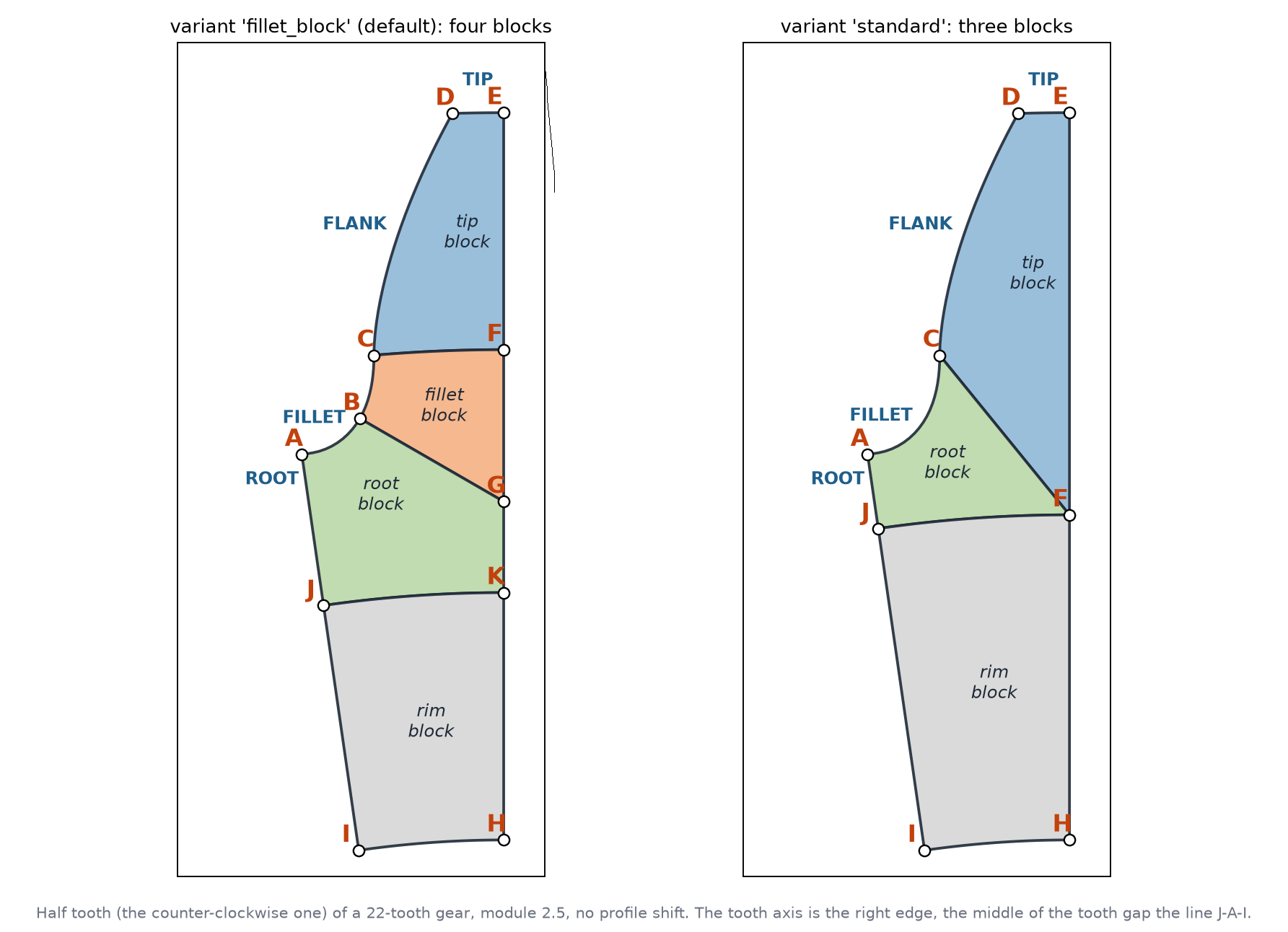
A useful gear mesh spends elements where they matter: along the contacting flank and the root fillet. The package uses structured transfinite blocks, recombined into quadrilaterals in 2D and extruded into hexahedra in 3D. The block-structured approach is inspired by GGGears; its code is not used.
One gear or a pair#
Continue the gear definitions in Quick start:
from gearbox.fem import ToothMeshSettings, mesh_gear, mesh_pair

settings = ToothMeshSettings(fillet_size=0.04, flank_size=0.06, order=2)
mesh = mesh_gear(pinion, "out", "pinion", "2D", settings, teeth=3)
pair_mesh = mesh_pair(transmission, "out", "pair", "2D", settings,
                      teeth=(3, 4), pinion_rotation=0.0)
print(mesh.node_count, mesh.element_count, mesh.min_quality)
pinion_rotation is a geometric mesh position in degrees, not the small bore rotation that
loads a contact analysis. At zero mesh rotation the pinion tooth axis lies on the line of centres;
solve_contact chooses a different default position so contact occurs at the pitch point.
Refinement and element quality#
Sizes are fractions of normal module. fillet_size and flank_size control surface resolution;
tooth_elements controls the count across half a tooth; surface_growth grades elements toward
the interior. settings.refined(2) roughly halves sizes and doubles relevant subdivision counts.
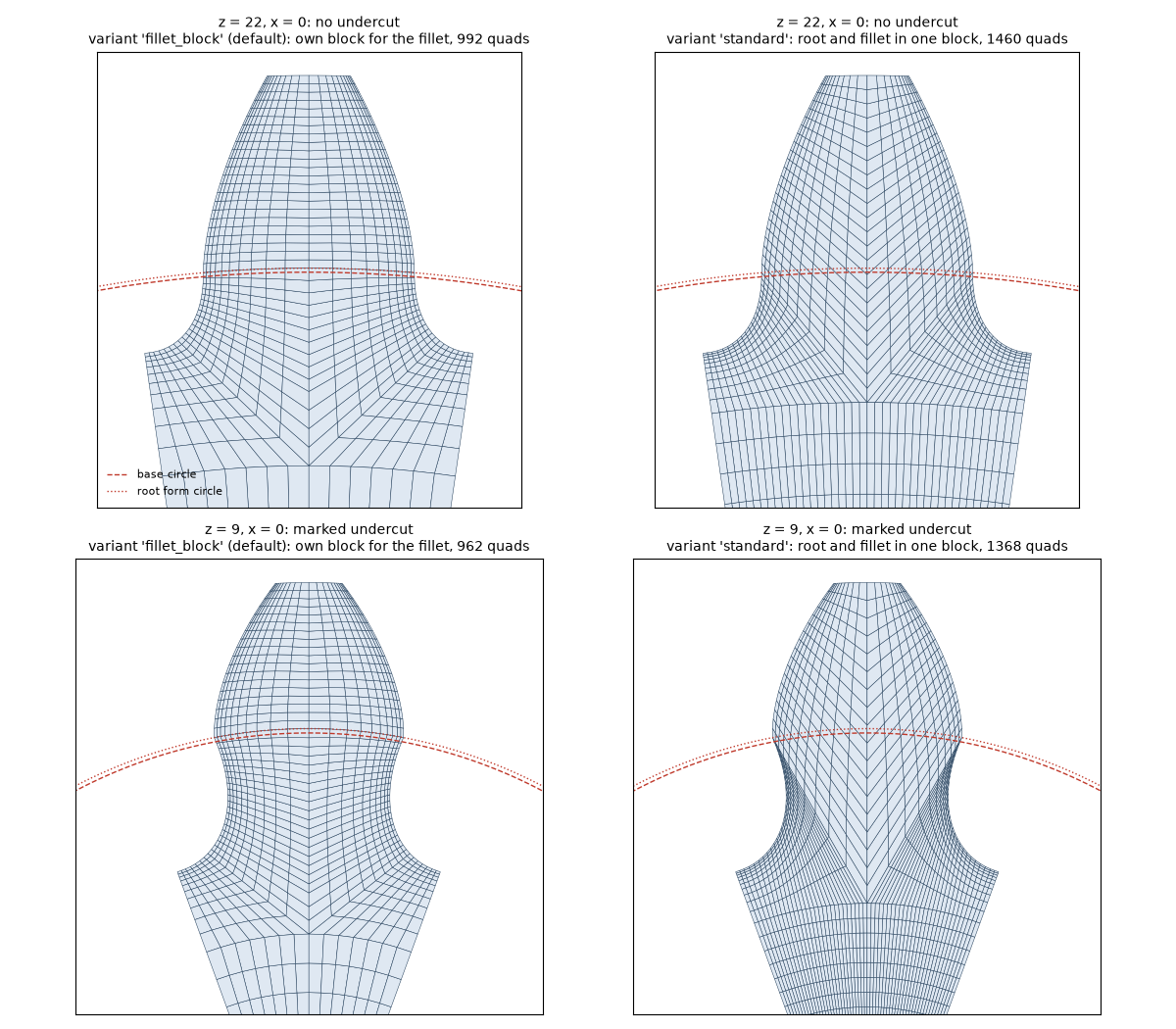
The default fillet_block layout gives the fillet its own block and closes the flank block at
the root form circle. The alternative standard layout combines more of the root region in one
block. Inspect the resulting elements rather than assuming one setting works for every undercut.
min_quality is the minimum scaled Jacobian. Nonpositive values indicate invalid or degenerate
elements, but a positive value alone does not establish convergence or penalize every aspect ratio.
Repeat the analysis with refinement and compare the quantity you intend to report.
Groups and files#
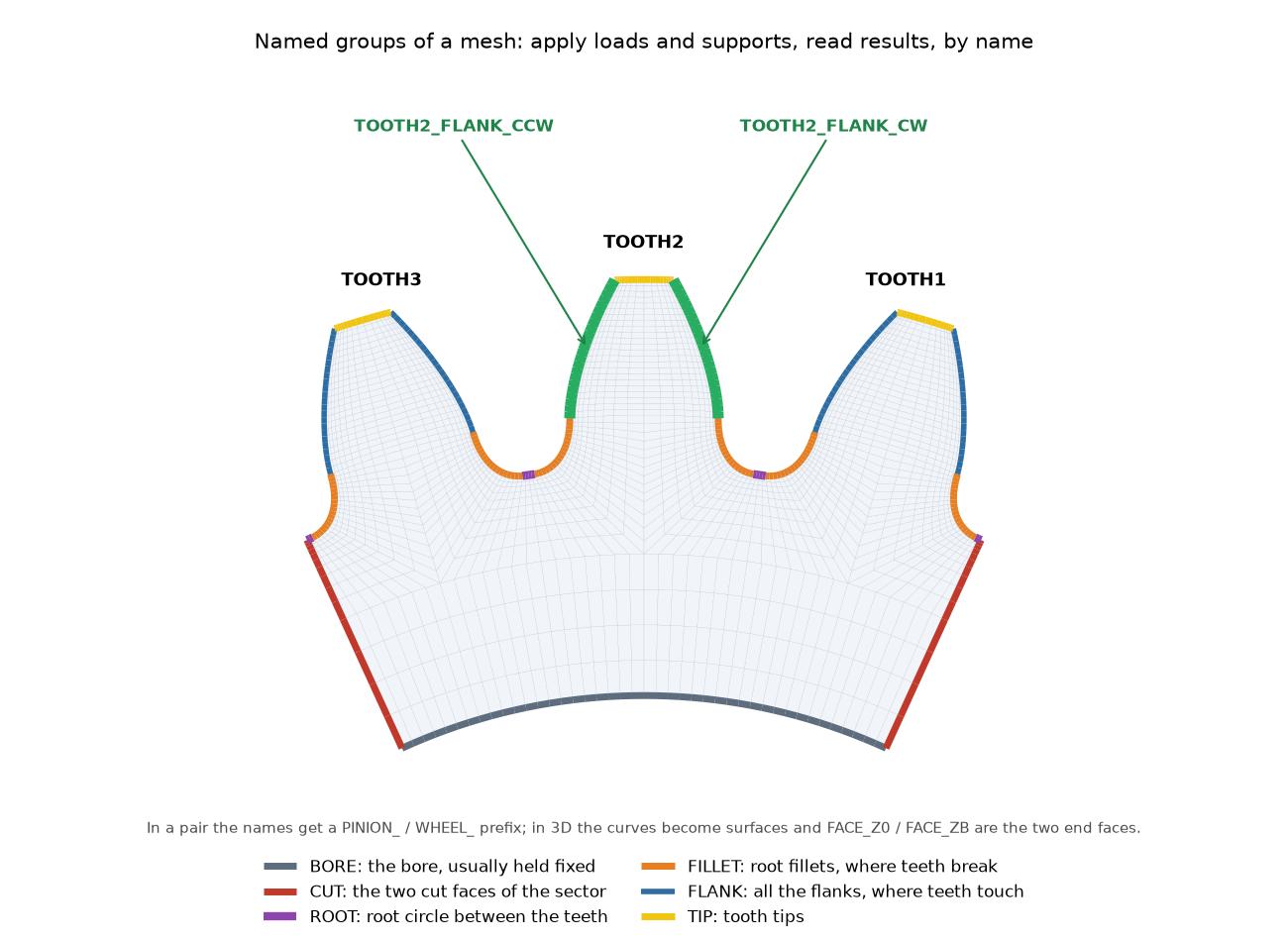
Physical groups include ROOT, FILLET, FLANK, TIP, BORE, GEAR and individual
TOOTH<n>_FLANK_CW/CCW groups. Partial sectors have CUT groups; 3D meshes also have
FACE_Z0 and FACE_ZB. Pair names begin with PINION_ or WHEEL_.
Meshes can be written as .msh, .inp or .vtk via formats. These mesh files are part of the
FEM workflow, not the legacy commercial-solver geometry exporters.
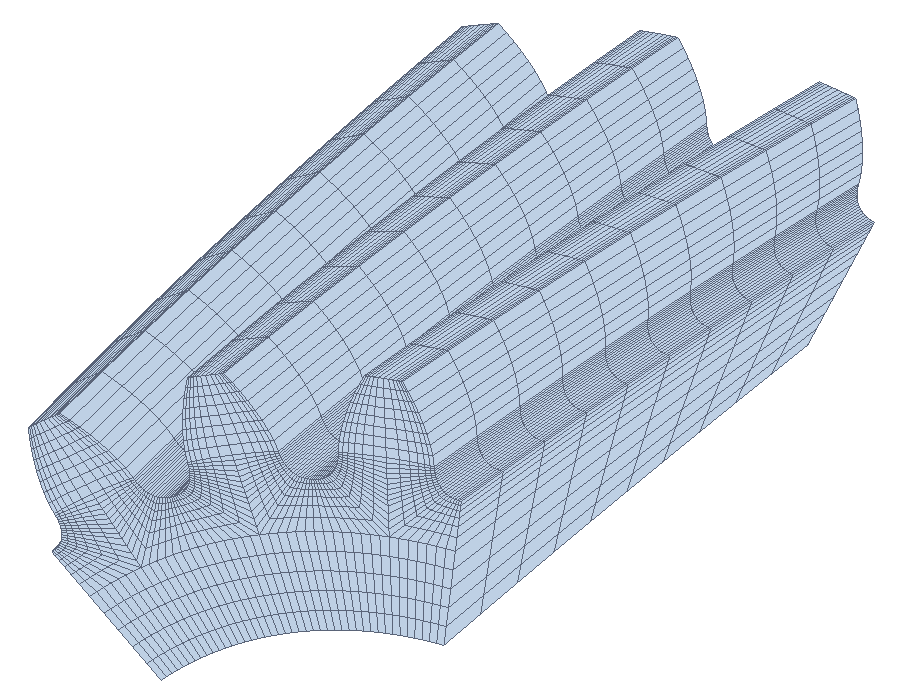
3D extrusion twists the transverse section along the helix. Specify width_elements to control
layer count; automatic layers based on flank size can make fine 3D contact models very large.
See gearbox.fem.mesh.ToothMeshSettings for every option.