
Post-processing and the full contact cycle#
One mesh position tells only part of the story. As a tooth enters and leaves contact, the curvature, lever arm and number of loaded pairs change. A quasi-static sweep solves these positions separately; it is not a transient dynamic simulation.
Positions on the line of action#
LineOfAction.of(transmission) describes the external pair in the transverse plane. Positions
are measured from pitch point C, positive toward E. A–B and D–E are double-contact regions for
ordinary spur pairs with contact ratio between 1 and 2; B–D is the single-contact region.
from gearbox.fem.post import LineOfAction, contact_sweep

line = LineOfAction.of(transmission)
print(line.points())
# Each requested position invokes a contact solve unless its cache is available.
points = contact_sweep(transmission, "out/sweep", [0.0])
A denser sweep gives smoother curves and animations but costs more solver runs. Reuse the same cache directory to redraw without solving unchanged positions again. The documentation figure generator requests 35 positions, up from 18, so its grid retains the old positions and adds 17 intermediate ones. Both generated animations contain 35 frames at 1920 × 1080 pixels, with 200 ms per frame.
Fields and contact patches#
contact_patches identifies contacting tooth regions using displaced coordinates.
nodal_field and stress_field prepare values for plotting; plot_mesh, plot_field and
plot_line_of_action draw on caller-owned matplotlib axes.
import matplotlib.pyplot as plt
from gearbox.fem.post import plot_field, plot_line_of_action

fig, ax = plt.subplots(figsize=(8, 7))
plot_field(ax, points[0].stress("von_mises"))
x, y = line.point(0.0)
ax.set_xlim(x - 8, x + 8)
ax.set_ylim(y - 7, y + 7)
plot_line_of_action(ax, line, points[0].followed.point)
fig.savefig("contact.png")
Reading the animations#
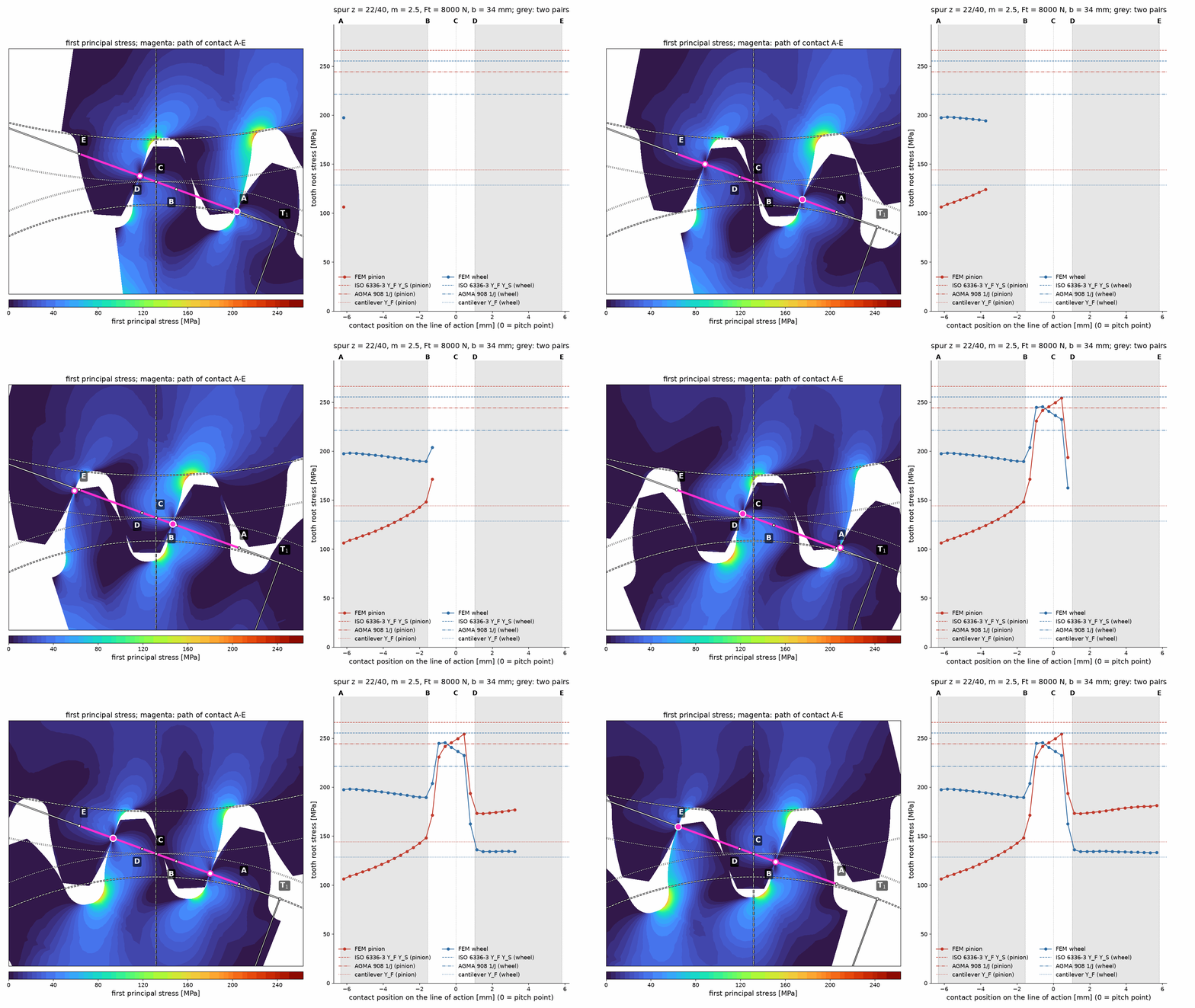
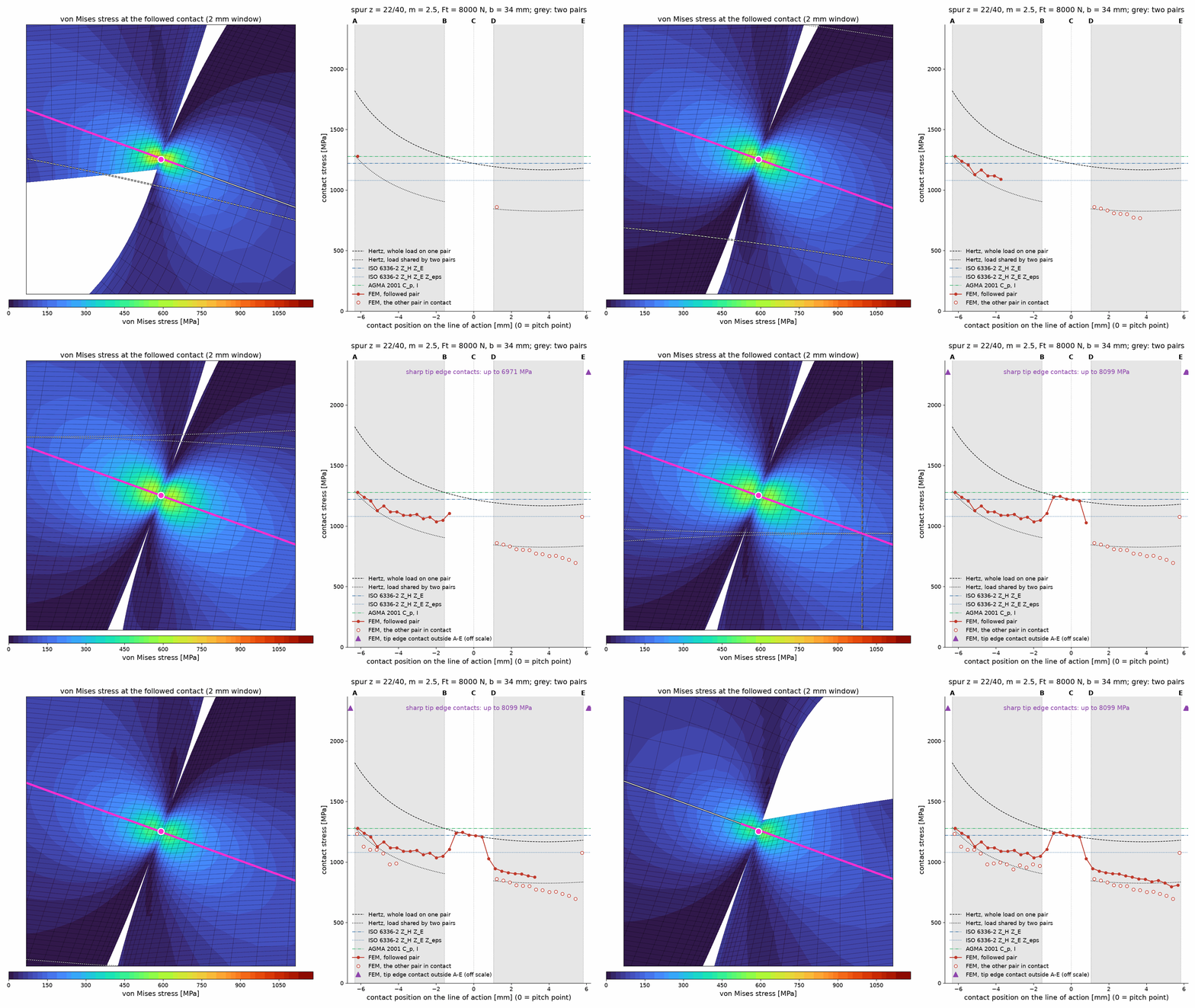
Grey regions indicate double-pair contact; in the central single-pair region one pair carries the whole load. Horizontal references are nominal analytical values, not targets every curve must hit. Tip-edge contacts are marked separately because their pressure peaks are not ordinary Hertz peaks.
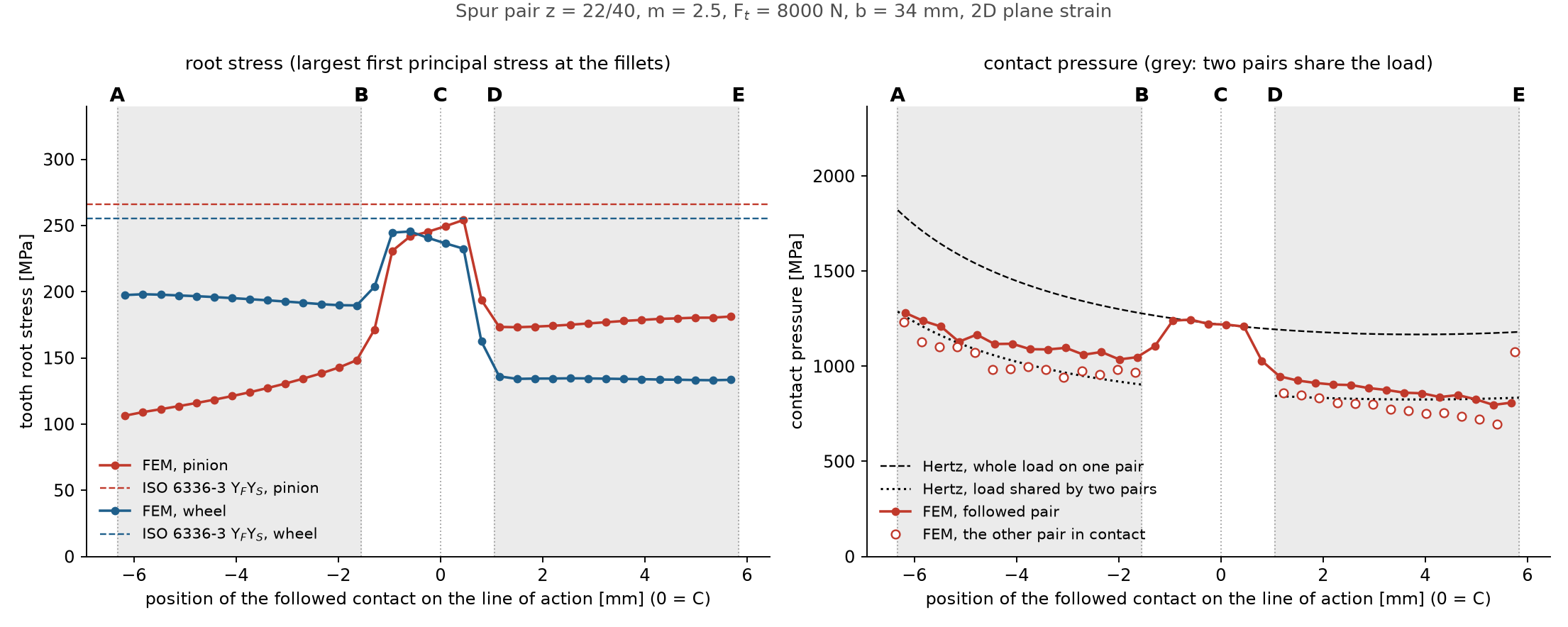
See gearbox.fem.post for the generated API and examples/08_fem_post_processing.py
for the complete workflow. A cache is computational convenience, not an independent validation
of the model or evidence of mesh convergence.