
Contact analysis#
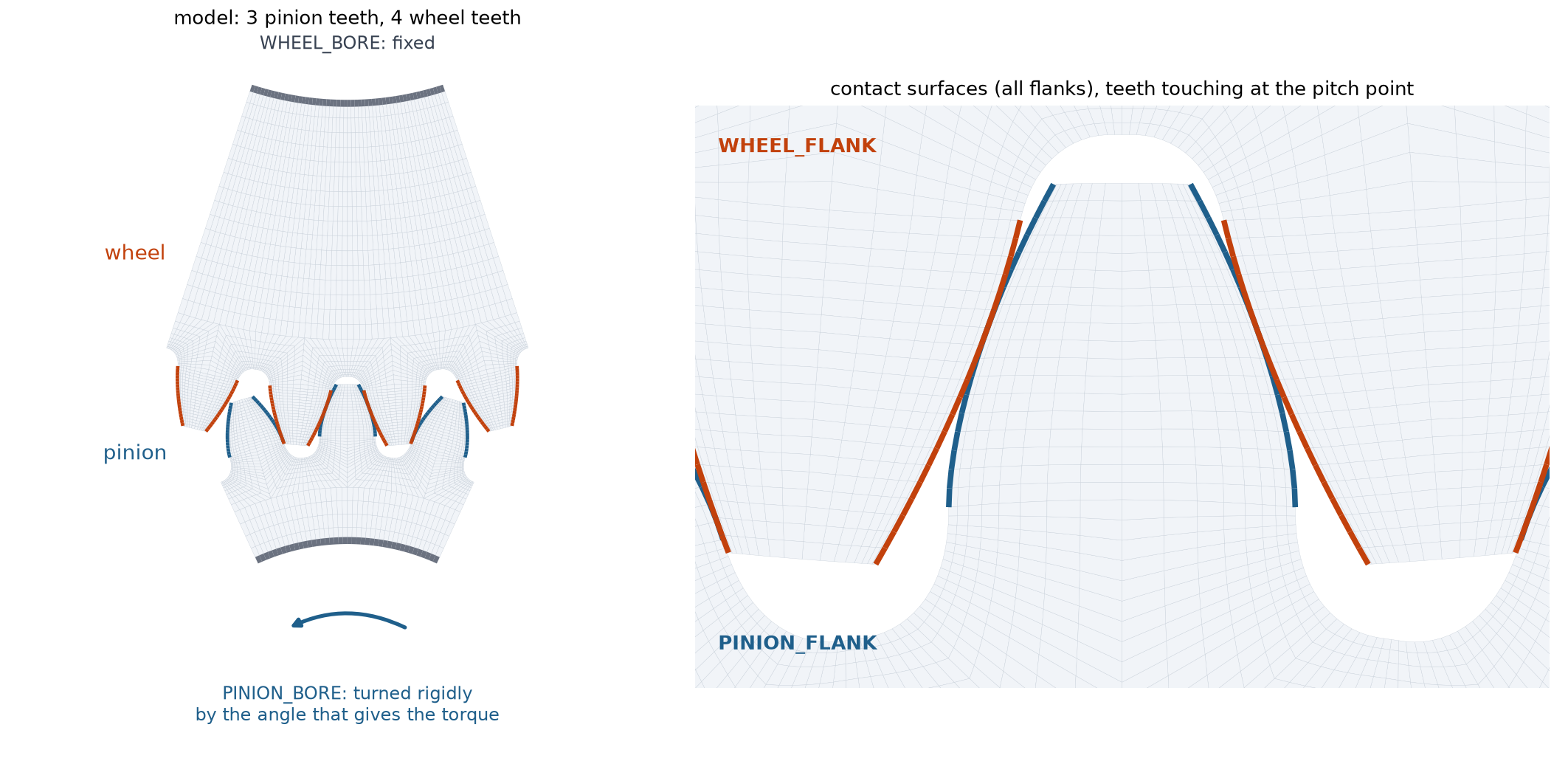
Contact is not a prescribed pressure distribution: the model has to discover which flank regions
touch and how the load is shared. solve_contact meshes both members and loads them through a
small rigid rotation of the pinion bore while holding the wheel bore fixed.
Constitutive and contact model#
The materials are isotropic and linear elastic. Contact is frictionless, surface-to-surface, with a linear pressure-overclosure penalty. The default stiffness is 100 times the larger Young’s modulus per mm. Small elastic strains do not make contact globally linear: the contact region changes with the applied load.
The solver adjusts bore rotation to bring the reaction torque within tolerance of
\(T=F_td_1/2\) (divided by the narrower face width in 2D). It allows up to four runs. Summary stresses
are then scaled by target/reached torque and peak pressure by its square root. Nodal arrays retain
the last run’s unscaled values; do not mix them with the scaled summaries without accounting for it.
from gearbox.fem import solve_contact

result = solve_contact(transmission, "out/contact")
print(result.max_contact_pressure)
print(result.applied_torque, result.requested_torque, result.runs)
A computed contact result#
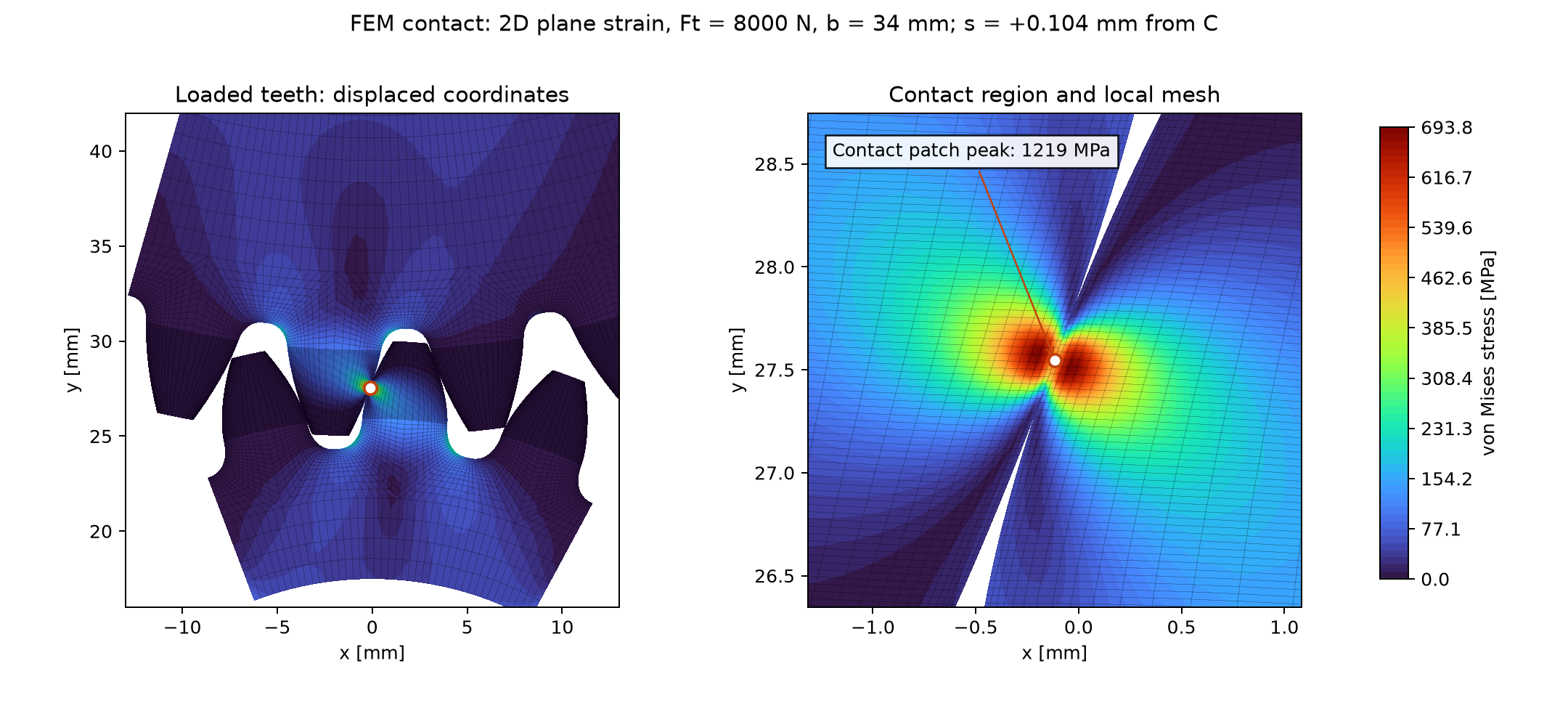
Actual cached CalculiX result for the 22/40 spur pair: 8000 N nominal tangential force, 34 mm width, 2D plane strain. The contact position is approximately +0.104 mm from C, not exactly the pitch point. The colour map shows von Mises stress, not contact pressure; the annotated pressure is the separately stored peak of the followed contact patch. Coordinates include computed in-plane displacements without an artificial deformation magnification.#
The local band of high stress is much smaller than the tooth. That is why a full-tooth mesh that looks fine at the left-hand scale may still be too coarse for contact. The right-hand view shows the mesh near the loaded flanks. This is a solver result at one position and one resolution, not a convergence study or a 3D validation.
The figure is regenerated from the existing sweep cache with
python docs/figures/fem_figures.py contact_result; the generator refuses to start a new solve if
the required position is missing. It does not reconstruct a fictitious nodal pressure map from
cached patch summaries.
Hertz reference#
For local line contact, define reduced modulus and radius
For normal force per unit contact length \(w\), the Hertz half-width and maximum pressure are
These are elastic half-space relations, not a whole-tooth model; see
Johnson. Compare under matching force, material and contact position.
LineOfAction.hertz_pressure provides the corresponding reference along the path.
Resolution and limitations#
The default CONTACT_SETTINGS has flank size 0.015 modules. The contact band must span several
elements: a coarse mesh or a soft penalty can widen it and shift the peak materially. Refine the
mesh and inspect penalty sensitivity before reporting a pressure.
At a sharp tooth tip, an apparent pressure peak can be edge-dominated and nonconvergent. Do not interpret it as an ordinary Hertz pressure. Loaded teeth can touch outside the ideal A–E path; real profile relief changes that behaviour.
The 2D spur cases are checked against Hertz in the test suite. 3D contact is available but expensive;
a coarse 3D solution is not validated merely because it converges. See
gearbox.fem.calculix.ContactResult for all output fields.