
ISO and AGMA: a controlled comparison#
Running two standards is easy. Comparing them meaningfully requires more care: keep the physical pair unchanged, record what each method assumes, and separate differences in calculated stress from differences in permissible material strength.
Neither method is a universal ground truth for the other. This chapter compares the implemented methods, including their current defaults and limits, rather than claiming equivalence of the standards in every application.
Start with the same physical problem#
The reference is the pair of Quick start:
Input |
Value |
|---|---|
Teeth |
22 / 40, external spur |
Normal module and pressure angle |
2.5 mm, 20° |
Face width |
34 mm on both members |
Profile shifts |
0 / 0 |
Pinion speed and power |
1450 rpm, 40 kW |
Required life |
10,000 h |
Application/overload input |
1.3 |
Accuracy |
ISO class 6; AGMA quality estimated by the package |
Material elastic properties |
206,000 MPa, Poisson ratio 0.3 |
Both methods therefore start with the same nominal tangential force, approximately 9579 N. Both use an elasticity coefficient of approximately 189.812 \(\sqrt{\mathrm{MPa}}\). Agreement on these quantities is a useful first check, not a guarantee of equal final stress.
Similar roles do not imply identical factors#
Physical role |
ISO implementation |
AGMA implementation |
What to watch |
|---|---|---|---|
External overload |
\(K_A\) |
\(K_o\) |
Same supplied application-factor field in this package |
Internal dynamics |
\(K_v\), methods B/C or measured |
\(K_v\), annex A quality/speed relation |
Different methods; identical symbols do not make values interchangeable |
Face load distribution |
\(K_{H\beta}\), \(K_{F\beta}\) |
\(K_m\) |
Different empirical treatment and required inputs |
Transverse sharing |
\(K_{H\alpha}\), \(K_{F\alpha}\) and geometry factors |
Sharing within geometry factors |
Avoid double counting by importing factors from the other method |
Contact geometry |
\(Z_HZ_\varepsilon Z_\beta\), \(Z_B/Z_D\) |
\(I\) |
Different grouping, contact evaluation and overlap treatment |
Root geometry |
\(Y_FY_S\) and related factors |
\(J\) and related factors |
Critical-section construction differs |
Thin rim |
\(Y_B\) |
\(K_B\) |
Applicability and fallback assumptions must be checked |
Material resistance |
\(\sigma_{Hlim}\), \(\sigma_{Flim}\) and ISO adjustments |
\(s_{ac}\), \(s_{at}\) and AGMA adjustments |
No automatic equivalence of the stress numbers |
For spur gears the normal and transverse modules coincide. For helicals the ISO bending expression uses \(m_n\), while this AGMA implementation uses \(m_t\) together with its own geometry factor. Substituting just one of those quantities would create a hybrid method, not a comparison.
Results for the reference pair#
Quantity |
ISO |
AGMA |
|---|---|---|
Dynamic factor |
1.0284 |
1.1239 |
Contact face-distribution factor |
1.0869 |
1.1931 |
Contact stress, pinion (MPa) |
1492.2 |
1845.6 |
Contact stress, wheel (MPa) |
1424.3 |
1845.6 |
Root stress, pinion (MPa) |
456.9 |
509.3 |
Root stress, wheel (MPa) |
438.2 |
462.1 |
AGMA returns a common contact stress with member-specific allowable stresses when material data are supplied. ISO additionally reports different applied member stresses through \(Z_B\) and \(Z_D\). The repeated AGMA value in the table is intentional, not an omitted wheel calculation.
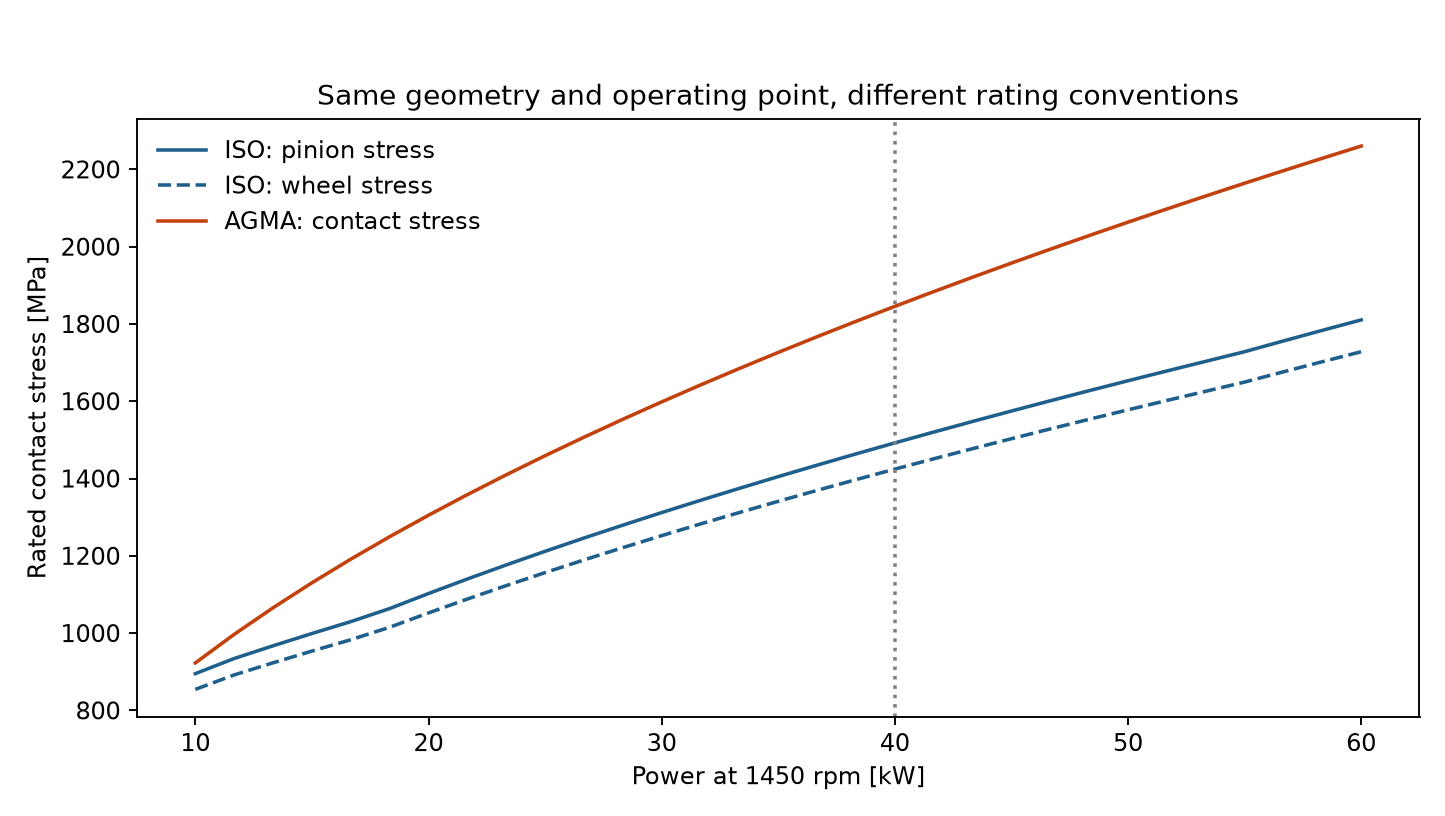
Power varies; geometry and speed remain fixed. All applicable factors are recalculated at every point. This is a comparison of ratings, not an experimental validation or a ranking of accuracy.#
The AGMA contact result is about 24% above the ISO pinion result for this case. The dynamic and face-distribution factors contribute, but they do not explain the entire difference: contact geometry and sharing are also grouped and evaluated differently. Do not generalize that percentage to other tooth counts, shifts, overlaps or accuracy classes.
The nominal Hertz peak at C is about 1334 MPa, with no rating load amplification. It is a third reference state, not a decisive arbiter between the two rated values. To compare a FEM solution, match load, position, material and load-sharing assumptions first; see Contact mechanics: from force to surface fatigue and Contact analysis.
Why the safety-factor comparison is deliberately incomplete#
The reference material supplies ISO contact and bending limits, giving ISO pinion factors of
approximately \(S_H=0.85\) and \(S_F=1.76\). It does not supply independently established AGMA
\(s_{ac}\) and \(s_{at}\). AGMA safety-factor fields are therefore None.
Copying the ISO values into the AGMA fields would produce numbers but not a scientifically justified comparison. A proper capacity comparison needs material stress numbers with traceable quality, heat treatment, reference life and reliability for each method. The same alloy name and hardness alone are insufficient evidence of that equivalence.
Reproduce the comparison#
Continue the quick-start definitions:
from gearbox.standards import iso6336, agma2101

iso_contact = iso6336.calculate_pitting(transmission)
agma_contact = agma2101.calculate_pitting(transmission)
iso_root = iso6336.calculate_bending(transmission)
agma_root = agma2101.calculate_bending(transmission)

print(iso_contact.contact_stress_pinion, agma_contact.contact_stress)
print(iso_root.tooth_root_stress_pinion, agma_root.bending_stress_pinion)
assert agma_contact.safety_factor_pinion is None  # AGMA material stress numbers were not supplied
docs/figures/contact_theory_figures.py regenerates the power sweep and prints the underlying
results. For a report, also record package version, input models, quality assumptions, supported
methods and applicable limitations; a screenshot of a curve is not a reproducible specification.
Choosing a method#
Use the standard required by your contractual or regulatory context. Use the other as a diagnostic cross-check, not to select whichever safety factor is larger. Where results diverge substantially, inspect the common load first, then dynamics, distribution, geometry and finally material resistance. That order turns disagreement into an engineering question you can investigate.